
Home > News > 6.7L Powerstroke Air & Cabin Air Filter — One Box for Turbo and Lungs

6.7L Powerstroke Air & Cabin Air Filter — One Box for Turbo and Lungs
Every 6.7L Powerstroke has two filters that almost nobody thinks about until something goes wrong. They get called “the forgotten filters” for a reason. The oil filter gets its change on schedule. The fuel filter gets swapped because the CP4.2 pump scares people into it. But the air filter and the cabin filter? They wait until the turbo starts whistling louder than it should, or the vents start blowing weak and smelling like a wet gym bag.
Here’s the thing those two filters have in common beyond the neglect: they’re the same problem wearing two different hats. The engine air filter protects the turbo from the outside air. The cabin air filter protects you from the same outside air.
Why “One Box” Isn’t Just a Marketing Convenience
Let’s kill the obvious objection first: “Why would I replace the cabin filter and the engine filter at the same time? They’re unrelated.”
They’re less unrelated than they look, and there are two reasons that actually hold up.
The Similar Service Life
Both filters live on roughly the same service clock — 15,000 to 20,000 miles or about once a year, shortened under hard use. If you’re already under the hood for one, the other is either due or about to be. Buying them as a pair means no second trip to the parts store when the cabin filter you “forgot about” finally gives up.
They Share A Partial Vacuum Zone
They’re not physically the same duct, but they draw from the same air and interact through the vehicle’s overall airflow resistance. When the cabin filter loads up, it adds resistance to the whole system — and a clogged cabin filter can contribute to unstable idle and poor throttle response on some platforms. Ford’s own service bulletins have flagged neglected cabin filters as a contributor to idle and drivability complaints.
So “one box for turbo and lungs” is the correct way to think about the two filters that manage your truck’s air.
The 6.7L’s Turbo: Why the Air Filter Is Its Only Line of Defense
Every diesel needs clean air, but the 6.7L Powerstroke has a specific reason to care more than most: its variable-geometry turbocharger is the most expensive single component on the engine, and it spins absurdly fast.
After The Air Filter Gets Clogged
The VGT turbo forces air into the cylinders by spinning fast enough to build boost. Everything it forces in has to pass through one filter first. When that filter begins to load, the whole system quietly changes character: the turbo spins faster to pull the same air through a tightening restriction, and exhaust gas temperatures climb in response. On a truck that’s towing hard, that EGT climb is what pushes pistons and turbo internals toward the edge.
When A Filter That Doesn’t Seal
At peak boost, the intake pulls hard on the filter element. If the gasket or the seating around the filter is even slightly off, dirty air slips around the filter — not through it — and heads straight into the compressor wheel. It pits the blade surface, throws the wheel out of balance, and permanently degrades the turbo’s efficiency. The damage is invisible until the turbo has to come out.
The air filter’s job is two things: catch the dirt and not choke the flow.
- A filter that only does the first is a filter that spikes your EGTs.
- A filter that only does the second is a filter that lets sand sandblast your compressor wheel.
Both failures happen quietly, with no warning light and no fault code, until the damage is done.
Know Your Generation: The 2011–2016 vs 2017+ Filter Split
Before you order anything, you need to know which air filter your truck takes — because the 6.7L changed filter designs, and the two generations do not interchange.
The Differences Between 2011–2016 vs 2017+ Filter
| Generation | Years | Air filter | Shape | Notes |
|---|---|---|---|---|
| Gen 1 / early Gen 2 | 2011–2016 | FA1902 (Motorcraft) | Flat panel | Seats in the factory air box; no foam wrap |
| Gen 2 (late) / Gen 3 | 2017–2019 | FA1927 (Motorcraft) | Cylindrical | Wrapped in a foam pre-filter; two locating pins |
- The 2011–2016 trucks use a flat panel filter (the FA1902).
- The 2017-and-newer trucks switched to a cylindrical filter with an outer foam pre-filter (the FA1927).
The two shapes are completely different, the air boxes are different, and there’s no way to make one fit the other.
The FA1927’s Foam Pre-Filter: What That Extra Layer Actually Does
The foam wrap is the first line of defense. It catches the coarse stuff — the chunky sand, the gravel dust, the debris that would otherwise slam into the pleated media and either clog it prematurely or, worse, work its way through. The foam extends the life of the pleated element underneath and keeps the media’s filtration efficiency from tanking early in dusty conditions.
There’s an install detail buried in that foam layer:
The foam faces the intake side. Get it backward and the coarse debris hits the bare pleats first — the foam does nothing, and the main media loads up way faster than it should. It’s a two-second check that a lot of owners skip, and it’s the single most common FA1927 install mistake.
This article focuses on the 2017–2019 platform, because that’s the truck the combo kit below is built for. If you own a 2011–2016 truck, the filter is a FA1902 panel — same principles, same protection logic, different shape. Either way, the first step in any filter purchase is confirming the generation.
The 99.5% Number, and Why Cheap Filters Come Up Short
The TruckTok FA1927 (and its combo-kit sibling) states a 99.5% filtration efficiency on multi-layer blended fiber media, wrapped in that outer foam. That number isn’t marketing fluff — it’s the entire point of the filter, and it’s the specific claim that budget listings quietly dodge.
Identifying Inferior Air Filters
Here’s the pattern that repeats across the whole aftermarket, and it’s worth memorizing because it shows up on every filter you’ll ever buy for this truck:
- A premium or OE filter states a number. Motorcraft says what it captures. TruckTok says 99.5%. The number is the filter’s whole value proposition on a VGT turbo.
- A budget filter states dimensions. The cheap listings tell you it’s “factory fit,” give you the millimeter measurements, and promise “easy installation” — and then say nothing about filtration efficiency, nothing about media material, and nothing about whether the gasket holds under boost.
The Pleat Count Tells The Same Story Visually
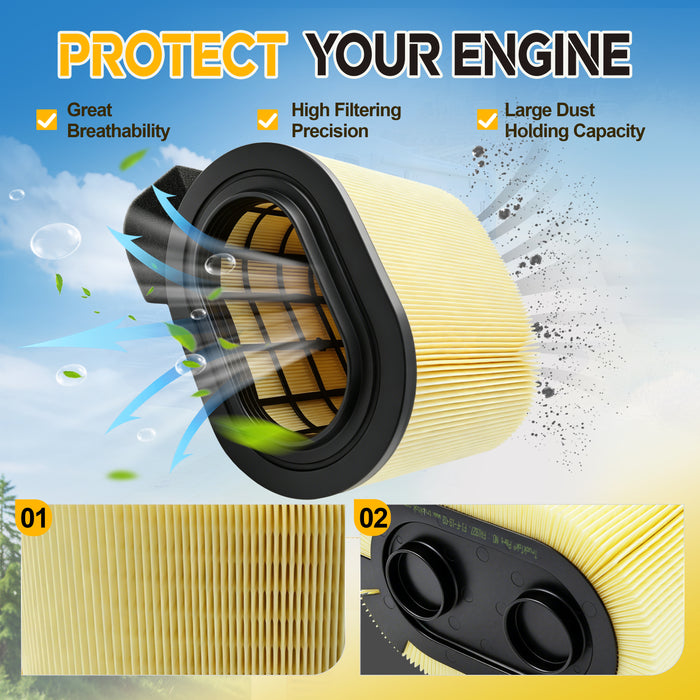
Hold a quality filter up next to a bargain one and count the folds. The quality filter has more pleats, which means more surface area, which means less restriction for the same filtration — the turbo isn’t pulling against its own filter. A filter with fewer, irregular pleats restricts flow earlier, and a restricted filter is exactly what drives the EGT spike you’re trying to avoid.
The Cabin Filter: Your Lungs’ Line of Defense
The Function of The Cabin Air Filter
The cabin air filter lives behind the glovebox, and its job is the same job in miniature: catch everything before it reaches a sensitive target — in this case, your respiratory system instead of a compressor wheel.
A standard cabin filter catches particulate down to about 5 microns — dust, pollen, mold spores, road debris. That’s the baseline, and it’s genuinely better than nothing. But a diesel truck lives in a harsher air environment than a commuter car. Construction dust, farm-field pollen, brake dust, and — most of all — diesel exhaust soot all hit that filter first. A Ram owner on a diesel forum described a good cabin filter extending the time between interior cleanings from two weeks to four months.
The Consequences of Not Replacing The Filter
The blower motor works harder against the resistance. The AC evaporator gets less airflow across its fins, so it cools less. The compressor runs longer. And you — the driver — breathe whatever the saturated filter has stopped catching.
Activated Carbon vs Standard vs HEPA: What the Data Actually Says
This is the question most truck owners are really asking when they shop for a cabin filter, and there’s a clear answer backed by actual measurement.
| Filter type | Particle capture | Odor / VOC removal | NO₂ reduction | Airflow resistance | Best for |
|---|---|---|---|---|---|
| Standard | Yes (down to ~5 microns) | No | Minimal | Lower | Clean rural, light use |
| Activated carbon | Yes (same particles) | ~94% odor neutralization | 64–67% | Slightly higher | Diesel, urban, towing, job sites |
| HEPA | 99.97% at 0.3 microns | No | High | Significantly higher | Allergy-sensitive, already-strong airflow |
The Numbers Behind Activated Carbon
- A 2025 University of Birmingham study measured in-vehicle NO₂ levels with different filters and found that activated carbon filters reduced NO₂ by 64 to 67% compared to standard filters.
- The windows closed and recirculation on, in-vehicle NO₂ was 14.3 times lower with a carbon filter.
- Separate 2023 automotive air-quality research found activated carbon neutralizes roughly 94% of odors and cuts VOC concentration by 82 to 87%.
For a diesel truck owner, that’s not a theoretical win. It’s the difference between smelling the exhaust of the semi in front of you and not smelling it. If you spend any real time in traffic, hauling, or on job sites, it pays for itself in a single summer.
HEPA Is A Different Tool For A Different Job
It captures the finest particles of all — 99.97% at 0.3 microns — but it does it by adding real airflow resistance. If your truck’s HVAC already blows weak, a HEPA filter will make it weaker. HEPA makes sense for allergy sufferers with a healthy blower system; it’s overkill (and a downgrade in airflow) for most diesel trucks.
Symptoms: How to Know It’s Time (Without Guessing)
Neither filter sends a warning light. You read the symptoms instead. Here’s the full list, split by which filter is talking to you.
Engine air filter (turbo side):
- A sudden 2-to-3 MPG drop on highway runs.
- Sluggish throttle below 2,000 RPM — the turbo is pulling against its own filter.
- A turbo whistling louder than normal under load, as it spins faster to overcome the restriction.
- EGTs that climb faster than they used to on the same tow.
Cabin air filter (lungs side):
- Weak airflow from the vents at every fan speed — the classic “all noise, no blow.”
- A musty or sour smell when the HVAC kicks on, especially after the truck sits.
- Foggy windows that the defroster can’t clear.
- Dust reappearing on the dash within days of cleaning.
- Allergy symptoms that get worse in the truck.
Two quick zero-tool checks from the driver’s seat:
- The hand test (fan on max, AC on, hand two inches from the center vent — clean-filter airflow should feel forceful)
- The audio test (fan stepped from low to high should get louder and move more air; if it gets louder but the air doesn’t follow, the filter is strangling the blower).
Pull the filter and look at it. A new filter is white or light gray. A loaded filter is dark gray to black, visibly packed — or, in the worst cases, home to something that crawled in there.
The Honest Answer on Replacement Interval
The standard advice says replace the air filter every 12,000–15,000 miles. The combo kit’s own spec says 15,000–20,000 miles or 12 months, sooner under hard use. But there’s a counter-argument floating around that’s also true: a slightly used filter often performs as well as, or better than, a brand-new one.
Don't Replace The Filter Too Early
A thin layer of trapped dust actually helps the media catch finer particles, and fleet tests on long-haul trucks have shown no horsepower loss — and sometimes slightly better fuel economy — on engines running lightly-used filters versus fresh ones. So the guy who swaps a new filter in every 5,000 miles “just to be safe” is spending money and, arguably, giving up a sliver of efficiency.
When Should It Be Replaced?
The real answer sits in the middle, and it’s condition-based, not calendar-based:
- Normal driving: 15,000–20,000 miles or 12 months, whichever comes first.
- Dusty, off-road, towing, or construction: 10,000–12,000 miles, or inspect at every oil change.
- Don’t rely on looks. The dense multi-fiber media in a quality diesel filter is too thick to pass light even when brand new, so the old “hold it up to the sun” test is useless on it. Replace by mileage or by the restriction indicator, not by appearance.
If your truck has a restriction indicator (the green-yellow-red slider on some air boxes), that’s the honest, mechanical version of the test: it reads restriction, not looks. When it slides toward red, the filter is done — regardless of what it looks like.
How to Choose a Good Filter: The Five-Point Checklist
Before you buy anything, here’s a filter-selection checklist you can run against any listing, in any price bracket. It’s the difference between picking a filter and being sold one.
1. It States A Filtration Number
A good filter tells you what it captures — “99.5%,” “OE-spec,” a rated efficiency. A bad filter tells you its dimensions and that it’s “factory fit” and “easy to install,” then goes quiet on efficiency. The number is the product. If a listing can’t or won’t state one, assume there’s a reason.
2. Count The Pleats
More pleats means more media surface area, which means less restriction for the same filtration — the turbo isn’t pulling against its own filter. Hold two filters side by side and the one with more, evenly-spaced pleats is the one that’ll let the engine breathe easy at 20,000 miles. Fewer, irregular pleats restrict flow earlier, and that’s what spikes your EGTs.
3. Look At The Gasket Material
The seal is the turbo’s second line of defense, and it takes real abuse under peak boost. A polyurethane gasket stays supple and holds its seal longer than cheap open-cell foam or thin rubber. On a VGT turbo, the seal is half the filter’s job.
4. Confirm The Foam Pre-filter (2017+)
This generation should come with the outer foam wrap. If a “FA1927 replacement” shows up without it, it’s been cost-cut — and the whole point of the foam is to eat the coarse sand before it hits the pleats.
5. Check The Cross-Reference List
The OEM cross-references (FA1927, HC3Z-9601-A, and so on) are the hard evidence that a filter actually interchanges — not a marketing claim, a part-number match. A complete cross-ref list means the seller did the homework.
Then match the media to your driving, and be honest with yourself about it:
- Paper / cellulose multi-fiber: the default, and the right call for dusty, towing, or daily use. Consistent, no maintenance, dry and disposable.
- Synthetic / foam: for highway and performance use where you want smooth flow and quick throttle response.
- Oiled cotton: only if you’ll actually maintain it — and you’re signing up to clean the MAF/MAP sensors on a schedule. In heavy dust, oiled media clogs faster and the excess oil is a sensor risk.
The Cost Math: One Box vs Buying Separate vs Going Cheap
Let’s put numbers on it, because the combo kit’s value only makes sense in context.
| Seller / option | Air filter | Cabin filter | Notes |
|---|---|---|---|
| TruckTok combo kit (F-19-03/19-04) | FA1927-style, foam-wrapped | FP92-style | $59.40 for both, one order |
| Motorcraft (dealer / parts store) | FA1927 ~$45–50 | FP92 ~$20–25 | Factory parts, bought separately |
| Premium aftermarket (Wix) | ~$75 | ~$25 | Brand premium, no spec advantage |
| Budget (Amazon / eBay no-name) | ~$18–24 | ~$10–15 | States dimensions, not filtration |
The pattern should be familiar by now. The premium brands charge for the name, not for a spec the TruckTok kit doesn’t meet. The budget tier charges less but states nothing — no filtration efficiency, no media material, no gasket spec — and on a VGT turbo, the filtration efficiency and the seal are the entire point. The combo kit at $59.40 lands at roughly half the cost of buying both factory filters separately, and a single order beats two trips to the parts store.
The Product: One Box, Both Filters
Here’s the kit this article is built around — the one that covers both the turbo and the lungs in a single order.
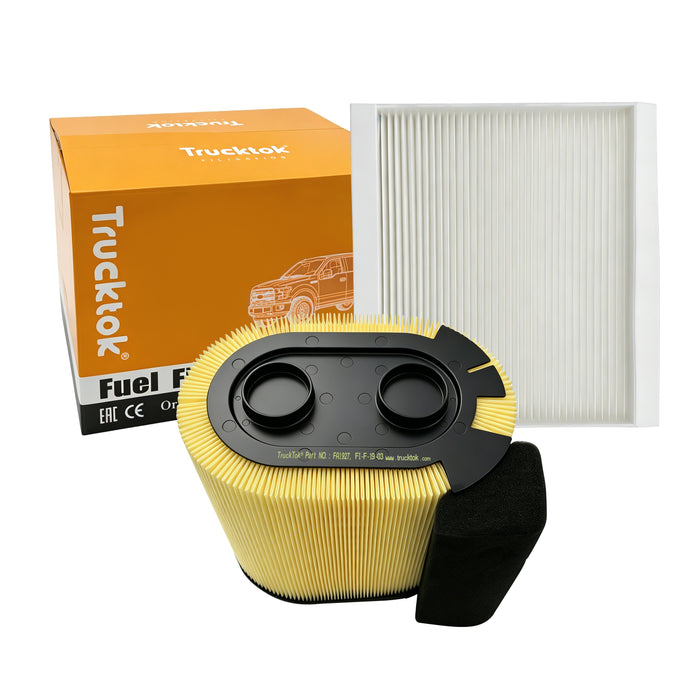
2017-2019 6.7L Ford Powerstroke Air & Cabin Air Filter
This 2-in-1 filter kit a heavy-duty cylindrical engine air filter (wrapped in an outer foam pre-filter) with a high-density cabin air filter. The engine filter blocks abrasive road dust and sand from scouring your turbo and cylinder walls, while the cabin filter keeps allergen-free airflow moving through the cab. Both match OE form factor and filtration spec, and both ship together in one package.
Fitment: 2017–2019 F-250, F-350, F-450, and F-550 Super Duty 6.7L diesel. Cross-references: air filter FA1927 / PA8219 / HC3Z-9601-A; cabin filter FP92 / Wix WP10266 / Baldwin PA10103 / Purolator TC38214.
Price: $59.40, in stock, free shipping. If your fuel and oil filters are due at the same time, TruckTok also bundles all four into a single 4-Filter Kit.
Installation: Step-by-Step, Tool List Included
Neither filter needs special tools, and neither takes long — call it 15 minutes each if you’ve done it before, a little more the first time. Here’s the full walkthrough, not the abridged version.
What you need:
- 7mm socket (on a ratchet or a driver — a driver is faster, a wrench works fine)
- A plastic trim tool or panel pry tool (not strictly required, but it makes the dash panel come off without breaking clips)
- A shop vacuum or a couple of microfiber cloths (for the airbox)
- A permanent marker (to label the cabin filter airflow direction so you never have to figure it out again)
- Optional: a Philips screwdriver as a backup
Engine Air Filter (FA1927)
-
Do it cold. Shut the engine off and let the turbo and intake cool. The air box clips are plastic and get brittle when hot, and the last thing you want is a face full of hot engine bay while you wrestle the lid.
-
Find the air box. On the 2017–2019 trucks it sits up front in the engine bay (usually the passenger side). The lid is held on by four or five spring clips around the perimeter — release them all.
-
Lift the lid and pull the old filter out. Before you toss it, note which way it sat — specifically, which side the foam pre-filter faced. Snap a quick photo or just remember it, because the new one goes back the exact same way.
-
Clean the housing. This is the step everyone skips, and it’s the one that matters most for longevity. Vacuum or wipe the dirt and grit out of the bottom of the air box. That loose sand is sitting right at the intake mouth — if you drop a fresh filter on top of it, the engine sucks it straight into the new element the moment you start it. Thirty seconds of cleanup is worth up to 30% more filter life.
-
Seat the new filter. Foam pre-filter toward the intake opening (toward the back, toward the connection), and line the two locating pins on the bottom of the filter up with their slots in the housing. It only fits one way — if it doesn’t drop in cleanly, you’ve got it spun wrong, so don’t force it.
-
Close and seal. Lower the lid and re-engage each clip one at a time, going around the perimeter. Then run your fingers along the seam and press to confirm the lid is seated flush all the way around — no lifted corners.
-
Reset the indicator. If your truck has a restriction indicator (the green-yellow-red slider on the air box), reset it back to green so it’s reading accurately for the new filter.
Cabin air filter (FP92)
The cabin filter lives behind the glovebox, and the 2017–2019 dash comes apart in a specific order. Work through it top to bottom:
-
Empty the glovebox — both the upper tray and the lower bin. You need room to work and you don’t want loose items raining down into the dash.
-
Open the glovebox and release the side latch. The latch (or side arm) clips to the glovebox door — pull it down and out to pop it free.
-
Drop the glovebox down. There are two tabs on the glovebox sides; push them inward and let the whole glovebox hinge down and out of the way.
-
Remove the rubber trim piece. It runs along the opening — just grip it and pull straight toward you. Set it aside.
-
Remove the two 7mm screws. They’re now exposed behind where the trim was.
-
Pull the dash panel off. Work a trim tool under the corner to get it started, then pull the whole piece free. It’ll still be connected to the airbag-switch wiring — you don’t have to disconnect it. Just swing the panel aside and leave it hanging.
-
Open the honeycomb door. This is the cabin filter access door — a honeycomb-shaped panel with a clip on each side. Hook a finger around each clip and pull straight toward you to pop the door open and fold it down.
-
Pull the old filter out. As it comes out, note the airflow direction — on the Super Duty it’s almost always top-to-bottom, and most filters print an arrow. Memorize it or write it down.
-
Slide the new filter in with the correct orientation. On the 2017–2019 Super Duty, air flows from top to bottom (downward).
CRITICAL CHECK: Look closely at the markings on the side of your new filter before sliding it in:
-
If it says “AIR FLOW” with an arrow, point the arrow DOWN (matching the direction of airflow).
-
If it says “UP” with an arrow, point the arrow UP (this indicates top-side orientation, not airflow direction).
Getting this backward forces air through the fine media layer first instead of the coarse pre-filter layer, clogging the filter prematurely and cutting HVAC airflow in half.
-
-
Reassemble in reverse. Fold the honeycomb door back up until the clips snap, reattach the dash panel and its two screws, press the rubber trim back in, hinge the glovebox up, and re-clip the side latch.
The two things that trip people up, again: the engine filter’s foam orientation, and the cabin filter’s airflow direction. Get those two right and the rest is just clips and screws.
The Six Install Mistakes That Quietly Damage Your Turbo
This is the part most guide articles skip, and it’s the part that actually costs money. A filter is only as good as its install. Here are the six ways people get it wrong — and what each one costs.
1. Installing The Filter Backward or Off-center
Diesel air filters are directional. The reinforced side (mesh or ribs) faces the incoming air to handle the turbo’s pull. Installed backward, the filter can deform under boost and leave gaps around the edges — and those gaps are tiny sandblasters aimed at your intake.
2. Ignoring The Airbox
When you pull the old filter, look down into the housing. If it’s dusty — vacuum or wipe it out before the new filter goes in. Drop a clean filter into a dirty box and that loose grit gets sucked straight into the new element the second you start the engine. Sixty seconds of cleanup can extend filter life by up to 30%.
3. Running An Oiled Filter Without Cleaning The Sensors
Oiled performance filters do flow more air — but they shed micro oil droplets that coat the MAF/MAP sensor. A contaminated sensor misreads airflow, and the truck starts over- or under-fueling: rough idle, black smoke, poor mileage, check-engine lights. If you run an oiled filter, you’re signing up to clean the sensors every 6,000–10,000 miles with a dedicated sensor cleaner.
4. Ignoring The Crankcase Breather Filter
Most modern diesels recirculate crankcase oil vapors back into the intake through a breather filter. When that filter clogs, the vapors mix with dust and stick to the turbo’s compressor wheel, forming a sticky film that restricts flow and builds soot. The rule of thumb is to check or replace the CCV filter every second air-filter change. It’s a tiny part that quietly extends turbo life.
5. Not Sealing The Edges
Even the best filter fails if it isn’t seated. A loose corner lets unfiltered air bypass the media and go straight into the turbo, the intercooler, and the cylinders. The fix is two seconds: run your finger around the seal before you clip the lid down. A cheap filter installed perfectly is safer than an expensive one installed wrong.
6. Forgetting The Cabin Filter Affects The Engine Too
We covered this up top, but it belongs on the mistake list. A clogged cabin filter adds resistance to the shared vacuum zone and can contribute to idle and drivability complaints. Replace it on the same clock as the engine filter — not just for the air you breathe, but for the air the truck breathes.
After the Swap: How to Extend Filter Life
A new filter isn’t a “set it and forget it” part. These habits are what separate a filter that goes the full 15,000–20,000 miles from one that loads up early — and they cost almost nothing.
1. Log the date and mileage. Write the install date and odometer reading on the filter box, or tuck a note in the glovebox. Next time the “is it time?” question comes up, you’re reading a number instead of guessing.
2. Stop pulling it out to “check it.” Repeatedly removing the filter wears the gasket and risks dropping debris into the intake. Judge by mileage, by the restriction indicator, or by a visual once a season — not by yanking it out every oil change.
3. Watch the restriction indicator, not the color. The dense multi-fiber media is too thick to pass light even when new, so the old “hold it up to the sun” trick is useless here. The restriction indicator (if you have one) reads actual airflow resistance — when it slides toward red, the filter is done regardless of how it looks.
4. Keep the airbox and intake mouth clear. When you’re under the hood, wipe the outside of the airbox and clear any leaves, dirt, or debris from the intake opening. A clean intake mouth means the filter isn’t eating junk before the air even reaches it.
5. Re-check the seal after break-in. Give the lid clips and gasket a quick once-over at 500–1,000 miles, and again after any heavy towing. Boost pressure works the seal, and a clip that loosened in the heat cycle is an open door for bypass dust.
6. Check the crankcase breather every second air-filter change. It’s the forgotten filter’s forgotten cousin. A clogged breather forces oil vapor into the intake, where it mixes with dust and gums up the turbo’s compressor wheel. Check or replace it on an every-other cycle.
7. Build cabin-filter-friendly habits. On dusty roads, heavy traffic, or when you’re following another diesel, run the HVAC on recirculate — it keeps the outside crud from loading the filter. Vacuum the carpets and seats regularly so you’re not cycling the same airborne dust through the filter. And don’t smoke in the cab; a cabin filter can’t un-smoke itself.
8. Never “clean” a dry filter with compressed air. The temptation is real — blast the dirt out and run it again. Don’t. High-pressure air tears microscopic holes in the pleats, and those holes become sand’s direct path into the turbo. A dry multi-fiber filter is a disposable part: when it’s done, it gets replaced, not revived.
That’s the whole maintenance philosophy in one line: install it right, then leave it alone and let it do its job — while you keep the environment around it clean.
Conclusion
Your 6.7L Powerstroke has two filters doing the same job for two different sets of lungs — yours and your turbo’s. Both load up at the same rate, both get ignored until they complain, and both are cheap to fix and expensive to neglect. The air filter is the only thing between a four-figure VGT turbo and a stream of abrasive sand. The cabin filter is the only thing between your lungs and whatever’s in the air around a working diesel truck.
They’re not two separate chores. They’re one air-management job, and the smart move is to treat them as such — one order, one afternoon, one box that covers both.
If you’re driving a 2017–2019 6.7L, grab the TruckTok Air & Cabin Air Filter combo. In stock, free shipping, and it replaces both your FA1927 and FP92 in a single order. If your fuel and oil filters are on the same clock, the 2017–2019 6.7L Complete 4-Filter Kit bundles fuel, oil, air, and cabin so every maintenance item is covered at once.
And if you’re on a different platform — a 6.4L Powerstroke, a Cummins, a Duramax — TruckTok carries the air and cabin filters for those too, same logic, same pricing model. Because on every diesel, clean air is cheap power, and the filter is where it starts.
Frequently Asked Questions
Q1: Why should I replace the engine air filter and cabin filter at the same time?
They run on the same 15,000–20,000-mile clock and both degrade at the same rate. Buying them as a combo means one order, one shipping box, and no second trip to the parts store when the “forgotten” cabin filter finally gives up. It’s also cheaper than buying them separately later.
Q2: What’s the difference between the 2011–2016 and 2017+ air filters?
The 2011–2016 trucks use a flat panel filter (FA1902), while 2017+ trucks use a cylindrical filter with an outer foam pre-filter (FA1927). The shapes and air boxes are completely different and don’t interchange, so confirm your generation before ordering.
Q3: Which way does the foam pre-filter face on the FA1927?
Toward the intake opening — the foam goes toward the back of the air box. It’s the coarse-particle first line of defense, and installing it backward lets debris hit the bare pleats first, loading the media far faster than it should.
Q4: Is an activated carbon cabin filter worth the extra money in a diesel?
Yes, usually. Carbon filters reduce NO₂ by 64–67% and neutralize roughly 94% of odors, which matters when you’re sitting in traffic behind other diesels. The premium is typically $5–10, and it pays for itself if you spend real time on the road.
Q5: Can I just clean my air filter instead of replacing it?
No — not a dry multi-fiber element. Knocking dirt out or blasting it with compressed air creates micro-tears in the pleats that let abrasive dust straight into the turbo. Dry filters get replaced, not cleaned. Only oiled reusable filters get cleaned, and they come with their own sensor-maintenance burden.
Q6: How do I know if it’s the filter or low refrigerant causing weak AC?
Use the hand test: weak airflow on every vent at every fan speed points to the filter. Low refrigerant causes warm air but usually keeps normal airflow. If the air is strong but not cold, suspect refrigerant; if the air is weak regardless of temperature, suspect the filter first — it’s the $20 fix.
Q7: Will replacing a clogged air filter actually restore power and MPG?
Yes. A restricted filter forces the VGT turbo to spin faster against an intake vacuum, spiking EGTs and costing you throttle response and 2–3 MPG. A fresh filter restores unrestricted flow and lets the turbo stop fighting its own filter. That’s the whole point of the 99.5% media and the deep pleats.
Q8: Does the cabin filter really affect how the engine runs?
Indirectly, yes. On many modern trucks the HVAC and intake systems share a partial vacuum zone, and a clogged cabin filter adds resistance to the whole system — which some manufacturers link to idle and drivability complaints. It’s one more reason to replace it on the same schedule as the engine filter.
Q9: Is this combo kit the same quality as the Motorcraft parts?
It matches OE form factor, filtration efficiency, and housing compatibility — the air filter states 99.5% efficiency with a foam pre-filter, the same engineering targets as the factory part, at roughly half the cost of buying both Motorcraft filters separately.
Q10: What if my fuel and oil filters are due too?
TruckTok sells a 2017–2019 6.7L Complete 4-Filter Kit that bundles fuel, oil, air, and cabin filters in one order, so you cover every maintenance item at once instead of chasing four separate purchases.