
Home > News > 6.4L Powerstroke Delete: The 400 Fix vs The 12,000 Rebuild

6.4L Powerstroke Delete: The 400 Fix vs The 12,000 Rebuild
You have two real options with a 6.4L Powerstroke: spend a few hundred dollars now to delete the emissions hardware that’s slowly diluting your oil, or wait until that diluted oil spins a bearing and write a $12,000 rebuild check. The math isn’t close — the question is timing, not whether.
For off-road / competition use only. Not legal for on-road use in emissions-regulated areas. Check your local, state, and federal laws before modifying any emissions-related component.
Why Does a 6.4L Ever Need a $12,000 Rebuild?
The 6.4L Powerstroke isn’t weak — it’s the compound twin-turbo, 350-horsepower engine that made Ford’s Super Duty genuinely fast. What kills it is the emissions system bolted on top, and one mechanism in particular: DPF regeneration.
Turns a $400 Problem Into a $12,000 Rebuild:
- The DPF fills with soot. It’s a ceramic trap in the exhaust, and it loads up every few hundred miles.
- The ECM triggers an active regen. To burn that soot clean, the computer injects raw fuel into cylinders #7 and #8 on the exhaust stroke, spiking exhaust temps to burn the filter.
- That fuel doesn’t all burn. Some of it washes past the piston rings, down the cylinder walls, and into the oil pan. That’s fuel dilution.
- Diluted oil stops lubricating. Diesel thins your oil, strips its film strength, and stops protecting the rod bearings and main bearings.
- A bearing spins. The metal-on-metal contact destroys the bearing, the crank journal, and usually the block itself.
The whole chain is invisible until step five. Your truck runs fine right up until the oil can’t protect the bearings anymore — and by then, the block and crank are junk.
Here’s What Each Link in That Chain Costs to Fix:
| Failed Part | How It Fails | Repair / Replacement Cost |
|---|---|---|
| DPF filter | Soot and ash plug the ceramic | $1,500–$2,500 (dealer $3,000–$4,000+) |
| DOC / catalytic converter | Clogging and heat damage | $800–$1,500 |
| EGR cooler (twin units) | Thermal cycling cracks the tubes | $2,000–$2,500 |
| K16 high-pressure pump + injectors | Metal wear from contaminated fuel | $4,000–$6,000 |
| Pistons (#7 and #8) | Heat cracking under regen spikes | $5,000–$10,000 (rebuild-level) |
| Lifter / camshaft | Roller bearing fails, grinds the cam | $2,500+ |
| Head gasket | Torque-to-yield bolts stretch | $2,000–$3,500 (cab-off) |
| Full engine rebuild | Spun bearing from diluted oil | $12,000+ |
The pattern is the point:
Almost every one of these starts with the emissions system — the regen that dilutes the oil, the coolers that crack, the heat that cooks the pistons. A delete removes the root cause; a rebuild is what you pay when you let it run until something on this list gives out.
What Does the $400 Fix Actually Stop?
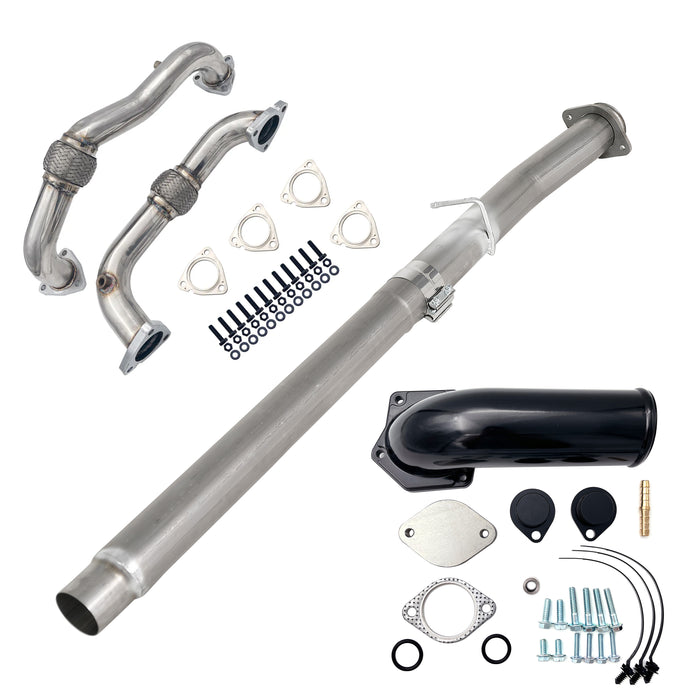
The “fix” here is a delete — physically removing the DPF and the EGR system so the regen cycle never runs again. The hardware itself runs a few hundred dollars (a pure 3-in-1 delete pipe-and-EGR kit lands right around the $400 mark), and it attacks the problem at the source:
-
It stops the regen. No DPF means no active regeneration, which means no post-injection fuel spraying into the oil. Fuel dilution drops to near zero.
-
It stops the EGR soot. The 6.4L runs two EGR coolers — a high-temperature and a low-temperature unit — that recirculate hot, soot-laden exhaust into the intake. Removing them ends the carbon sludge that coats the intake and the cracked-cooler coolant leak risk.
-
It removes the backpressure. A free-flowing exhaust drops EGTs and takes heat load off the turbos and pistons.
The point isn’t more horsepower — a delete doesn’t add power, the tune does. The point is that you’re removing the one system that’s actively destroying your oil and bearings from the inside out.
What Does “Waiting Too Long” Actually Look Like?
This is where the $12,000 number stops being theoretical. Two real teardowns show exactly what fuel dilution does when it’s ignored.
The 86,000-Mile Spun Bearing
One shop pulled a 6.4L with only 86,000 miles on it — it ran fine, no smoke, until it started knocking. They cut the oil filter open and found brass shavings. When the pan came off, they found the thrust washers sitting in the bottom — they’d come off the main bearing. One main bearing had spun in its housing, worn paper-thin and sharp as a razor blade.
Their conclusion was blunt: the block and crank are junk. The heads might be saved, but the rotating assembly was done. This is fuel dilution, run to its logical end, in under 90,000 miles.
The 165,000-Mile Rebuild That Still Failed
The second case is the one that should scare you more, because it shows the rebuild isn’t a guaranteed out. This 6.4L owner had already spent $30,000 to $40,000 on an engine build five years earlier — upgraded internals, turbos, the works. It ran for about 50,000 miles, then started ticking. By the time it reached the shop, it was banging through the intake and had no oil pressure.
The teardown found the real culprit: a lifter had ground into the camshaft, its roller bearing disintegrated, and the needle bearings had passed through — and destroyed — the oil pump. No oil pressure, scored cylinders, cracked heads, and a block, crank, cam, and piston set that were all junk.
Is a Delete the Same as a Rebuild? No — and That’s the Honest Part
A delete is not bulletproofing. It removes the emissions system that’s the biggest accelerant of 6.4L failures — but it does not fix the engine’s own internal weak points:
-
Cracked pistons. The 6.4L’s pistons are a Ford design, cast thin, and prone to cracking under heat and shockwave — the #7 and #8 cylinders that run hot during regen are the usual victims. A delete lowers that heat, but a cracked piston is still a cracked piston.
-
Lifter and cam failure. The 165,000-mile truck above didn’t fail from emissions — it failed from a lifter grinding the cam. That’s a valve-train design weakness no pipe can fix. The shop that rebuilds 6.4Ls upgrades to a Max Force piston and still treats the lifter/cam as a known failure point.
-
Head bolts, not studs. The 6.4L uses torque-to-yield head bolts that stretch and weaken over time. Push big horsepower through a tuned truck and the head gasket is a known weak link.
So the honest framing is: a delete removes the single most common, most expensive, and most preventable failure cause. It doesn’t make a 6.4L indestructible. What it does is stop the one failure that’s guaranteed to happen if you leave the emissions system alone .
The Data Comparison: Delete vs Rebuild
| Path | Cost | What You Get |
|---|---|---|
| Pure delete hardware (pipe + EGR kit) | ~$400 | Stops regen and fuel dilution; needs a tuner |
| All-in-one delete kit with pre-loaded tuner | ~$ 1,460 | Everything in one box, ready to install |
| DPF + SCR replacement (dealer) | $2,000–$4,000+ | Puts the same failure-prone system back on |
| EGR cooler replacement | $2,000–$2,500 | Fixes one cooler; the twin can still crack |
| Full rebuild (spun bearing / lifter) | $12,000+ | Engine-out, block and crank replaced |
The spread is the point. A delete — even the complete kit with a tuner — costs less than a single dealer emissions repair, and a fraction of a rebuild. The expensive outcomes are what happen when you leave the regen cycle running until the oil can’t take it anymore.
What Are the Three Worst Flaws a Delete Removes?
For a 6.4L, the “three flaws” line up with the three things a single teardown behind the firewall removes all at once.
Flaw 1: DPF Regen Fuel Dilution
The active regen injects fuel on the exhaust stroke of #7 and #8, and some of it always washes into the oil. It’s the #1 cause of the spun bearings you see in 6.4L teardowns. Remove the DPF and the regen never runs — no post-injection, no dilution.
Flaw 2: Twin EGR Cooler Cracking
The 6.4L’s two EGR coolers — high-temp and low-temp — crack under thermal cycling. When they do, coolant leaks into the intake and the combustion chamber, showing up as white smoke with no external leak, and eventually hydrolocking a cylinder and bending a rod. Removing both coolers deletes the failure point entirely.
Flaw 3: Up-Pipe Bellows Cracking
The up-pipes carry exhaust from the manifolds to the turbos through flex bellows that fatigue and split. A split bellows leaks exhaust before the turbo, killing spool and blowing soot into the engine bay. A quality delete kit replaces these with interlocking stainless bellows at the same time it’s doing the EGR and exhaust work — one teardown, three fixes.
The Product: The All-in-One Kit That Ends the Regen
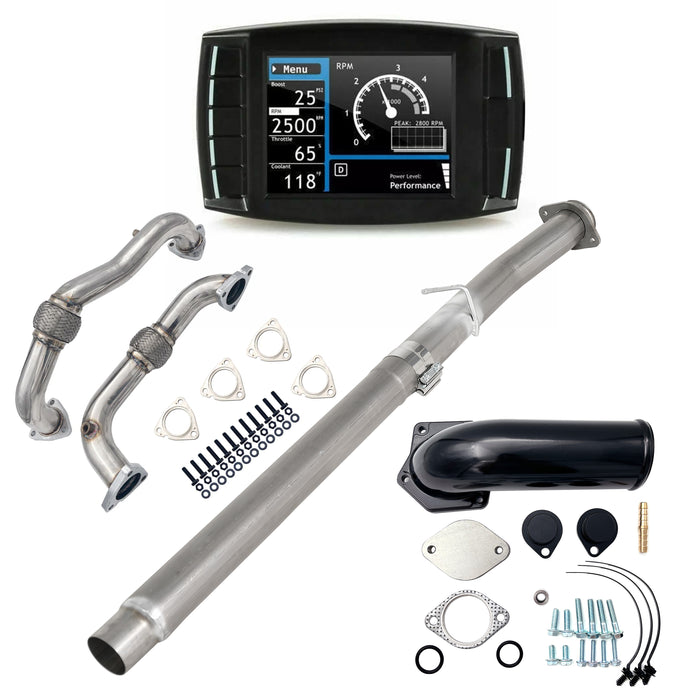
The cleanest way to stop the fuel dilution before it stops your bearings is a complete kit that removes the DPF, both EGR coolers, and the failure-prone up-pipes in one pass — with the tuner already loaded.
The 2008–2010 6.4L Ford Powerstroke 4" DPF & EGR Delete All-in-One Kit is built for exactly this:
- 4" mandrel-bent exhaust removes the DPF and catalytic converter, stopping active regeneration and the fuel dilution that comes with it.
- Dual EGR cooler delete eliminates both the carbon sludge in the intake and the coolant-leak hydrolock risk.
- Up-pipe replacement with interlocking stainless bellows fixes the third common failure point while you’re already at the firewall.
- Pre-loaded Mini Maxx V2 tuner means the calibration ships with the kit — flash it, remove the hardware, and the ECM runs clean.
It fits the 2008–2010 F-250, F-350, F-450, and F-550, including Cab & Chassis trucks, and it bundles all three fixes into a single teardown so you don’t pay the firewall labor three times. If you’d rather supply your own tuner, the hardware-only 4" Cat & DPF Delete Pipe & EGR Delete Kit covers the same pipe and EGR work for around $400.
How to Choose: Hardware Only, or the All-in-One Kit?
There are two ways to buy, and the difference is the tuner.
-
Hardware-only (≈$400): A pipe and EGR kit that removes the physical components. You supply your own tuner and tune, and you’re responsible for matching the calibration to your year and configuration. Cheaper up front, more legwork.
-
All-in-one with a pre-loaded tuner (≈$1,460): The pipe, the EGR delete, the up-pipes, and a Mini Maxx V2 tuner with the calibration already loaded. You flash the tune, remove the hardware, and the ECM never throws a code or enters limp mode.
The all-in-one is the lower-risk path for a first delete, because the tune and hardware are matched out of the box. The golden rule holds either way: flash the tune first, then remove the hardware. Removing a DPF or EGR system without a tune will trigger a check-engine light and limp mode within miles.
What the Install Actually Involves
A 6.4L delete is an involved DIY job — the EGR coolers and up-pipes live behind the firewall, in the tightest part of the engine bay. Give yourself a full day the first time, and don’t start until the tune is in hand.
Tools You’ll Need
- 8mm, 10mm, 13mm, 15mm sockets, plus a deep 10mm for the EGR fasteners
- Torx bits, extensions, swivels, and a pry bar for the firewall work
- Penetrating oil (PB Blaster) — spray every exhaust and EGR bolt 24 hours before you start
- New coolant (the system holds 28–30 quarts) and a drain pan
- Torque wrench for the manifold and clamp hardware
- Ratchet strap to support and separate the heavy DPF canister
- Heat gun or torch for breaking rusted bolts loose
- Battery charger to keep the ECM alive during the tune flash
Step 0: Flash the Tune First (Non-Negotiable)
This is the rule that decides whether your truck drives home or sits in limp mode. Flash the delete tune into the ECM before you unbolt anything.
- Hook up a battery charger so voltage doesn’t drop mid-flash and brick the module.
- Load the calibration for your exact year and configuration.
- Only after the tune is confirmed loaded do you start turning wrenches.
Remove hardware without the tune and the ECM will throw a wall of DTCs and derate the truck within miles.
Step 1: Prep the Truck
- Park on level ground, set the brake, and chock the wheels.
- Let the engine cool completely — exhaust and EGR hardware stays hot for a long time.
- Disconnect both battery negatives before touching anything electrical.
- Drain 2–3 gallons of coolant through the radiator petcock or lower hose into a pan.
- Lift the front and set it on jack stands — never work under a jack alone.
Step 2: Remove the DPF/CAT Section
The DPF/DOC assembly is the heavy part, and it’s a two-piece slip-fit, not a single can.
- Unplug every sensor on the DPF and DOC, and label each connector so you know where it goes back.
- Remove the downpipe-to-DPF flange bolts and the mid-pipe connection.
- Loosen the exhaust hangers and the band clamps — if they’re rusted, hit them with heat and an impact wrench.
- Hook a ratchet strap to the frame rail and pull the slip-fit sections apart to separate the joint (the slip-fit inserts about two inches).
- Lower the canister — it’s 60+ pounds, so support it before the last hanger comes off.
Step 3: Install the Delete Pipe
- Test-fit the 4" pipe into the downpipe and tail section before tightening anything.
- Align the flanges, then work the clamps front to back so the pipe sits straight.
- Use a new gasket and band clamp — reusing a crush gasket is how you get an exhaust leak.
- Snug everything down, then go back and torque to spec after the rest of the job is done.
Step 4: Remove Both EGR Coolers
This is the cramped part — the two EGR coolers sit against the firewall, and the top-rear bolts are the ones everyone fights.
- With the coolant already drained, disconnect the coolant lines feeding both coolers.
- Remove the high-temperature cooler (exhaust side) first, then the low-temperature cooler.
- Block off every open port with the kit’s plates, making sure the mating surfaces are clean before the gaskets go on.
- Reroute the coolant circuit so it doesn’t dead-head — a blocked path traps air and starves the rear cylinders of coolant. This is the step budget kits skip, and it’s the difference between a clean delete and an overheat.
Step 5: Replace the Up-Pipes
You’re already at the firewall, so this is the time to fix the third failure point.
- Remove the old up-pipes and their cracked flex bellows.
- Install the T-304 stainless up-pipes with interlocking bellows.
- Torque the manifold hardware evenly — the goal is a leak-free seal on the hot side.
Step 6: Refill and Burp the Cooling System
The 6.4L cooling system is big and air-locks easily, so the burp is not optional.
- Refill with the correct coolant to the 28–30 quart capacity.
- Run the heater on full and idle with the degas cap off until the thermostat opens and the air bleeds out.
- Top off, then recheck the level after the first heat cycle.
Where It Usually Goes Wrong
- Reversing the order — pulling hardware before the tune is in, and landing in limp mode.
- Skipping the coolant reroute — the most common cause of post-delete overheating and rear-cylinder damage.
- Not labeling the sensors — a connector put back on the wrong port turns into a ghost code that’s a nightmare to trace.
- Over-torquing the plastic — the 6.4L has plastic fittings and covers that crack if you lean on them.
Get the Right Kit for Your 6.4L
The decision really comes down to one question: is this truck still worth saving? If it runs, and you want it to keep running, the delete is the cheap insurance that stops the failure you can’t see coming. If you wait until the oil is full of fuel and the bearings are gone, you’re not deciding anymore — you’re paying for a rebuild.
Either way, the 6.4L rewards the owner who acts before the knock. The full 6.4L Powerstroke delete lineup at TruckTok covers the pipe, the EGR delete, the up-pipes, and the tuner — matched to your exact cab, bed, and configuration, so you get the $400 fix instead of the $12,000 rebuild.
Frequently Asked Questions
Q1: How much does a 6.4L Powerstroke delete actually cost?
A: The hardware alone — a DPF/EGR delete pipe and block-off kit — runs around $400. A complete all-in-one kit with a pre-loaded tuner lands near $1,282. Either way, it’s far less than a $12,000 rebuild.
Q2: Does a delete add horsepower?
A: Not on its own. The delete removes restriction and stops the regen cycle, which improves response and drivability, but the power gain comes from the tune you pair with it. A delete is a reliability mod, not a power mod.
Q3: What causes a 6.4L to need a full rebuild?
A: Most commonly, fuel dilution from DPF regen. The regen injects fuel into cylinders #7 and #8, some of which washes into the oil and strips its lubrication, eventually spinning a rod or main bearing and junking the block and crank.
Q4: Can I just wait until the DPF or EGR actually fails?
A: That’s the trap. Fuel dilution does its damage silently while the engine still runs fine — the first symptom is often a spun bearing, by which point the engine is already destroyed. Waiting means betting against a failure you can’t detect.
Q5: Does a delete make a 6.4L bulletproof?
A: No. It removes the emissions system that’s the biggest accelerant of failure, but cracked pistons, lifter/cam wear, and torque-to-yield head bolts are internal weak points a pipe can’t fix. It’s insurance against the most common failure, not a guarantee.
Q6: Do I have to delete the EGR if I delete the DPF?
A: Yes, in practice. The EGR and DPF are linked, and leaving the EGR coolers in place keeps a soot source and a coolant-leak risk. A proper delete removes both systems together.
Q7: What’s the install order for a 6.4L delete?
A: Flash the delete tune first, with a battery charger connected, then remove the hardware. Removing a DPF or EGR system without a tune will throw a check-engine light and put the truck into limp mode within miles.
Q8: Does a delete improve fuel economy?
A: Modestly. Real-world gains are usually 1–3 MPG, and the bigger benefit is eliminating the regen fuel waste and the fuel dilution in your oil — not a dramatic mileage jump.
Q9: Is a 6.4L delete legal on the street?
A: No. Removing emissions equipment violates the federal Clean Air Act and is for off-road, competition, and closed-course use only. On a street truck, it voids warranty and fails inspection.
Q10: How long does a 6.4L delete take to install?
A: Plan a full day for a first-time DIY. The EGR coolers and up-pipes live behind the firewall in the tightest part of the engine bay, and the DPF canister is heavy enough to need support.
Q11: What’s the difference between the 4" and 5" exhaust?
A: The 4" is the balanced choice for daily driving and towing, with good flow and less cab drone. The 5" flows more and sounds deeper, but it’s aimed at high-power builds and can drone on the highway.
Q12: Will deleting stop my 6.4L from cracking pistons?
A: It reduces the risk by lowering EGTs and removing the regen heat spikes that stress cylinders #7 and #8, but it doesn’t eliminate the piston’s design weakness. A mild tune and watching EGTs under load are still essential.
For off-road / competition use only. Not legal for on-road use in emissions-regulated areas. Check your local, state, and federal laws before modifying any emissions-related component.