
Home > News > 2020-2024 EcoDiesel DPF Delete: The Kit Older Trucks Can't Use
2020-2024 EcoDiesel DPF Delete: The Kit Older Trucks Can't Use
If you’ve got a 2020 or newer Ram 1500 EcoDiesel, the delete kit for a 2014-2019 truck won’t fit it — and it’s not just a fitment quirk. FCA redesigned roughly 80% of the engine and locked the ECU down so hard that the tuning path is completely different. Here’s what actually changed between generations, and why you can’t shop this platform with the older truck’s playbook.
For off-road / competition use only. Not legal for on-road use in emissions-regulated areas. Check your local, state, and federal laws before modifying any emissions-related component.
What Changed Between the Generations — and Why It Matters
The 3.0L VM Motori V6 in the Ram 1500 comes in two distinct generations, and they’re not interchangeable. Treating them as the same engine is the single most common — and most expensive — mistake on this platform.
| Gen 2 (2014-2019) | Gen 3 (2020-2024) | |
|---|---|---|
| Factory rating | 240 hp / 420 lb-ft | 260 hp / 480 lb-ft |
| Wheel dyno (stock) | ~200 whp | ~220 whp |
| ECU | Early FCA architecture, OBD-flashable | Highly encrypted, bench flash only |
| Redesign | Original | ~80% redesigned (BGI generation) |
| Turbo | Original | New turbocharger |
| EGR | Standard | Revised system + low-pressure exhaust loop |
| SCR | Original | 50% larger with a new oxidation catalyst |
The engine block is essentially the same displacement and layout, but the supporting hardware — turbo, EGR routing, exhaust geometry, and ECU calibration — changed enough that platform-specific kits are non-negotiable.
Why a 2014-2019 Kit Won’t Bolt Onto a 2020+ Truck
The short answer is geometry, and then encryption. Two separate walls:
The Hardware Wall
The 2020+ EcoDiesel uses a redesigned chassis layout with entirely different piping angles and lengths. A delete pipe built for the 2014-2019 platform won’t line up with the 2020+ flanges, and the EGR block-off hardware doesn’t match the revised intake plumbing. This isn’t a “close enough” situation — it’s a won’t-bolt-on situation.
The Software Wall
The 2014-2019 trucks can be OBD-flashed with tools like EZ Lynk or a handheld loader. The 2020+ trucks run an encrypted ECU that blocks standard OBD programming entirely. To tune a 2020-2024 EcoDiesel, you remove the ECM, ship it out for a bench flash, and wait roughly 1.5-2 weeks while it’s unlocked and programmed. There’s no OBD shortcut on the Gen 3 platform.
The lesson in one line: if a listing says “EcoDiesel delete pipe” without specifying the generation, it’s probably a 2014-2019 part — and it won’t fit your 2020+.
Why Do We Need EcoDiesel DPF Delete: The Regen Cycle
The reason an EcoDiesel delete makes sense isn’t horsepower — it’s that the DPF regeneration strategy is quietly hurting the bottom end.
The Fuel Dilution Problem
- During active regen, the ECU injects extra fuel on the exhaust stroke purely to spike exhaust temperature hot enough to burn soot.
- Some of that fuel washes past the piston rings and into the oil pan.
- That fuel dilution thins the oil — and the 3.0L EcoDiesel has a documented weakness in its main and lower-end bearings.
The Oil Tells the Story
One owner who put 70,000 trouble-free miles on a factory-replacement engine pointed out the tell in a maintenance video: his 10,000-mile oil came out still golden, not the instant-black diesel owners expect.
- The carbon grit that turns oil black is abrasive.
- Running carbon-laden, fuel-thinned oil through the mains is, in his words, like running sand through them.
- A delete that stops the regen cycle also stops the fuel dilution feeding that exact failure.
How Much Power Does a Delete Actually Add?
The cleanest before/after data on this platform comes from a dyno comparison of a 2018 EcoDiesel — three stock pulls, then a delete kit with a 50-horsepower economy tune:
| Measurement | Stock (wheel) | Delete + 50 HP tune (wheel) |
|---|---|---|
| Horsepower | 196 hp | 275 hp |
| Torque | 347 lb-ft | 510 lb-ft |
Two things stand out:
- The +79 wheel horsepower blew past the 50-hp tune rating — the tuner expected maybe 50 and got 80.
- Note the stock number: 196 wheel hp versus the 240 hp Ram advertises, which is just normal crank-to-wheel driveline loss.

The critical caveat: the power comes from the tune, not the pipe. The delete pipe removes restriction and stops regen, but the +79 whp is the fueling and boost changes from the tune. A pipe alone adds no horsepower — which is exactly why tuning is non-negotiable.
For the 2020-2024 Gen 3, the tune comes as a bench flash in fixed levels — typically base, +50 HP, and +75 HP — rather than the on-the-fly switching some older platforms support.
Check These Three Recalls Before You Spend a Dollar
Before you buy delete hardware, run your VIN through the NHTSA recall lookup. Three federal recalls cover parts on these engines, and the dealer does them free.
-
EGR cooler (19V757 / VB1) — about 108,000 Ram 1500 trucks from 2014-2019. The factory cooler can crack from thermal fatigue and let coolant into the intake, which NHTSA flags as a fire risk.
-
High-pressure fuel pump (22V406 / Z46) — about 138,600 vehicles. The Bosch CP4.2 pump can fail and send metal debris through the entire fuel system.
-
Crankshaft tone wheel (20V475 / W58) — about 58,000 trucks. The tone wheel can delaminate and stall the engine.
A delete kit doesn’t touch the fuel pump or the crankshaft, so if you have an open recall of that kind, get it done first — it’s free and it’s unrelated to your delete.
The Transmission Is the Real Ceiling, Not the Engine
Most delete guides bury this, and it’s the thing that bites people hardest. The 3.0L EcoDiesel’s factory transmission is rated for roughly 500 lb-ft of torque. Look back at that dyno table — the deleted truck made 510 lb-ft at the wheels.
You’re at or past the stock transmission’s rating the moment you load a real tune. That has three practical consequences:
- Transmission tuning is not optional. It firms up shift points, raises line pressure, and prevents the slipping and hard shifts from overloading a stock calibration.
- You have to let it relearn. After flashing, the transmission’s adaptive shift memory is cleared. Drive gently through the gears a few times before hammering it.
- The internals cap your ambition. Cast-iron rods and cast-aluminum pistons give you a safe ceiling around 400 wheel horsepower, and the stock turbo starts running out of breath around 325 whp.
On this platform, a delete is a reliability and efficiency upgrade, not a drag-strip build. The power is a side effect, not the point.
Matching the Delete Pipe: Built Specifically for the EcoDiesel 2020-2024
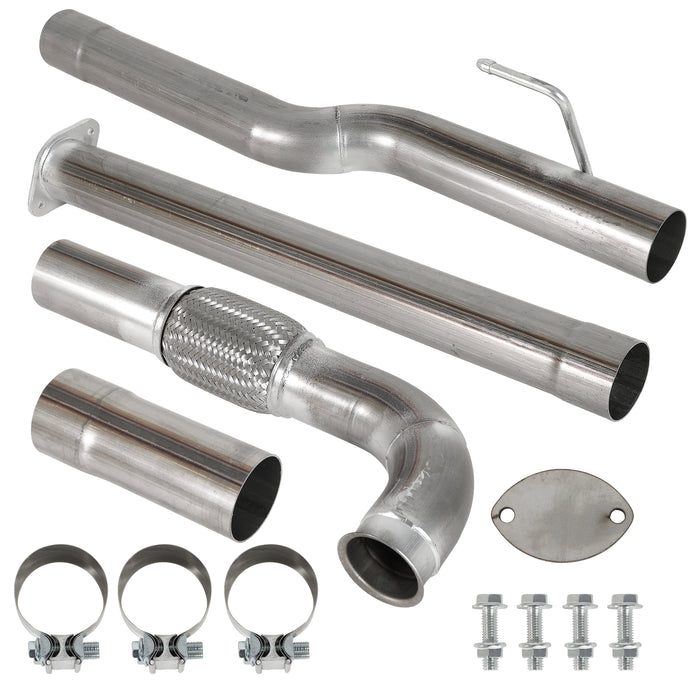
If you’ve got a 2020-2024 Ram 1500 EcoDiesel, the right part is the TruckTok 3" DPF Delete Race Exhaust Pipe — built for this generation, not a repurposed 2014-2019 part.
-
What it replaces: the factory mid-section, from the stock turbo downpipe flange to the stock tailpipe inlet. It drops the integrated DOC, DPF, and SCR canisters in one piece while leaving the downpipe and tailpipe intact.
-
Why it’s generation-specific: the 2020+ chassis uses different piping angles and lengths than the older trucks. This pipe is mandrel-bent T-409 stainless with pre-welded OE-style hangers, so it bolts to the factory mounts without fabrication — but only on the 2020-2024 geometry it was designed for.
-
What it fixes: it removes the DOC, DPF, and SCR restriction, and it eliminates the NOx and EGT sensors that are the source of so many sudden check-engine lights and 5-MPH limp-mode countdowns. With the regen cycle gone, unburnt diesel stops washing into the oil pan.
-
What it doesn’t do: it’s not a horsepower part by itself. The gains come from the mandatory delete tune — and on the Gen 3, that tune is a bench flash, not an OBD job.
How the Install and Tuning Actually Work
On the 2020-2024 platform, the order of operations matters more than on older trucks, because the tuning path is a bench flash.

Step 0: Tune First, Always
This is non-negotiable and the #1 mistake people make. Never remove hardware before the tune is ready.
- The Gen 3 ECU can’t be OBD-flashed — you remove the ECM and ship it for a bench flash, with roughly 1.5-2 weeks of downtime.
- While the ECM is out, order the delete pipe and gather the hardware so everything is ready when it comes back.
- Reinstall the flashed ECM, then confirm no check-engine light before touching any hardware.
Step 1: Remove the Factory Mid-Section
- Unplug every sensor and wire on the DOC/DPF/SCR assembly — DEF injector, NOx sensors, EGT sensors.
- Break the V-band clamp at the downpipe. This is the single worst fastener on the job, and it’s often seized — budget penetrating fluid, heat, and a pry bar.
- Drop the old assembly. Either unbolt it clean or sawzall it out; the old hardware is scrap either way.
Step 2: Hang the New Pipe
- Bolt the delete pipe to the factory mounts and OE-style hangers.
- Confirm the flanges line up — this is where a wrong-generation pipe reveals itself immediately.
Step 3: Verify and Drive
- Check every clamp for exhaust leaks, then drive gently while the transmission relearns.
- Expect 4-6 hours for a first-timer, longer on a rust-belt truck.
The Legal Reality (Read This Before You Commit)
Removing emissions equipment from a road-registered vehicle violates the Clean Air Act (42 U.S.C. §7522), with individual civil penalties up to about $5,911 per violation, adjusted for inflation. States with OBD-based inspection — California, New York, Texas, and others — will fail a deleted truck. Delete kits are sold for off-road, competition, and export use, and that label does not create a legal exemption.
For off-road / competition use only. Not legal for on-road use in emissions-regulated areas. Check your local, state, and federal laws before modifying any emissions-related component.
Get the Right Kit for Your EcoDiesel Generation
The 3.0L EcoDiesel is a capable engine saddled with an emissions system that works against it — and the 2020-2024 trucks are a different animal from the ones everyone’s older forum posts were written about. If your Ram 1500 EcoDiesel lives off-road or in competition, match the kit to the generation: a 2014-2019 pipe won’t bolt onto a 2020+, and the 2020+ needs a bench flash, not an OBD tune. TruckTok carries the platform-specific pipe for the 2020-2024 Ram 1500, so you’re not gambling on a “universal” listing that doesn’t fit.
Related Blogs:
-
2020-2024 Ram 1500 EcoDiesel DPF Delete Race Pipe: Stop the 5-MPH Limp Mode
- 3.0L EcoDiesel DPF & EGR Delete Guide: What You Need to Know
- How Do You Fix the Ram 1500 EcoDiesel Heat and Soot Problem? The Long-Haul Reliability Blueprint
- Ram EcoDiesel 3" DPF Delete Pipe Install (2014-2018 Models)
- Ram 1500 EcoDiesel Air and Cabin Filter Guide (68441763AA)
Frequently Asked Questions
What’s the difference between the 2014-2019 and 2020-2024 EcoDiesel?
The 2014-2019 (Gen 2) makes 240 hp/420 lb-ft and supports OBD flashing. The 2020-2024 (Gen 3) makes 260 hp/480 lb-ft, is roughly 80% redesigned with a new turbo, revised EGR, a low-pressure exhaust loop, and a 50% larger SCR — and its encrypted ECU requires a bench flash instead of an OBD tune.
Will a 2014-2019 delete kit fit my 2020+ Ram EcoDiesel?
No. The 2020+ chassis uses completely different piping angles and lengths, so a Gen 2 pipe won’t line up with the flanges, and the EGR hardware doesn’t match the revised intake plumbing. Shop a kit that explicitly lists 2020-2024 compatibility.
How much power does a delete add?
On a dyno, a 2018 EcoDiesel gained +79 wheel horsepower (196 to 275) and +163 lb-ft with a 50-hp tune. The power comes from the tune, not the pipe — the pipe removes restriction and stops regen. A pipe alone adds no horsepower.
Do I need a tune if I delete my 2020-2024 EcoDiesel?
Yes, and on this generation it’s a bench flash — you ship the ECM out for roughly 1.5-2 weeks. The ECU is encrypted and can’t be OBD-flashed. Tuning must be done before hardware removal.
Why is the transmission a concern on the EcoDiesel?
The stock transmission is rated for about 500 lb-ft, and a tuned delete already makes 510 lb-ft at the wheels. Transmission tuning is required to prevent slipping, and you must let it relearn after flashing before pushing it.
Is the EGR cooler a real problem on this engine?
Yes. NHTSA Recall 19V757000 covers 2014-2019 Ram and Jeep EcoDiesels whose EGR cooler can crack and leak coolant into the intake — a fire risk. Check your VIN before buying hardware; the recall repair is free.
What recalls should I check before deleting?
Three federal recalls cover these engines: the EGR cooler (19V757), the Bosch CP4.2 high-pressure fuel pump (22V406), and the crankshaft tone wheel (20V475). A delete doesn’t touch the fuel pump or crankshaft, so get any open recall done free first.
Does deleting improve fuel economy?
Yes, typically 3-5 MPG in real mixed driving, from roughly 19 MPG stock to 25-27 deleted. The gain comes from eliminating regen cycles and reducing backpressure. Claims of 10+ MPG are marketing, not reality.
Does the delete itself add horsepower?
No. The horsepower comes from the tune. The pipe removes restriction and stops the regen cycle, but the +79 whp on the dyno was the tune’s fueling and boost changes, not the pipe.
What does the regen cycle do to the engine?
Active regen injects extra fuel to burn soot, and some of that fuel washes past the rings into the oil. That fuel dilution thins the oil, which is especially dangerous on the 3.0L EcoDiesel’s known weak main bearings.
Is deleting a 2020-2024 EcoDiesel legal?
No for road use. Removing emissions equipment violates the Clean Air Act, with individual penalties up to about $5,911 per violation. Deletes are legal only for off-road, competition, and non-road use, and that label is not an exemption.
Can I install a delete kit myself?
Yes, with basic mechanical experience, a lift or ramps, and patience — expect 4-6 hours. The V-band clamp at the downpipe is the hardest part. The tuning step on a 2020+ is a bench flash you can’t DIY, so budget the downtime.