
Home > News > 6.7 Cummins EGT Relocation Kit Install (2013+ Ram DIY Guide)
6.7 Cummins EGT Relocation Kit Install (2013+ Ram DIY Guide)
Author’s Note: Written after doing this on my own 2018 Ram 2500 in my driveway with basic hand tools. If I can do it without dropping a wrench into the engine bay, you can too.
I still remember the moment the tuner handed me my delete pipe and said, “You’ll need to move the EGT sensors too.” I looked at the factory sensors buried inside the DPF and thought — how hard could it be?
Turns out, the relocation itself isn’t hard. What’s hard is figuring out which kit works for your year, what thread pitch your sensors are, and whether you need to weld anything. I bought the wrong kit twice before getting it right.
This guide covers exactly what I learned — the hard way — so you get it right the first time.

Why You Even Need an EGT Relocation Kit
When you remove the DPF on a 2013+ 6.7 Cummins, you’re also removing the factory mounting points for your EGT sensors. There are typically 3-4 sensors in the exhaust stream:
- EGT 1 — Pre-turbo (exhaust manifold) — stays put
- EGT 2 — Post-turbo, pre-DPF — needs relocating
- EGT 3 — Inside the DPF — gets deleted with the pipe
- EGT 4 — Post-DPF (some models) — gets deleted
Your ECU still wants to see temperature readings from those sensors. Without them, you’ll get codes like P0544, P2031, or P242B — and your truck might go into limp mode.
The solution: move the sensors you’re keeping (usually EGT 2) to the delete pipe or exhaust manifold, and code out the ones you’re losing with your tune.
Important: This kit is for relocating sensors you’re keeping. If your tune disables EGT monitoring entirely, you don’t need this. But if you’re running a tune that still reads EGT data (most do for safety), you need to relocate.
Before You Start: 2013 vs 2013+ Sensor Threads
This is the #1 mistake people make. 2013 Ram EGT sensors use M14x1.5 threads — not the M12 that generic kits come with.
| Year | EGT Sensor Thread | Kit Needed |
|---|---|---|
| 2007-2012 | M12x1.25 | Generic kits work |
| 2013+ | M14x1.5 | Needs specific adapter |
I learned this after buying a $28 universal kit on Amazon, jacking up the truck, crawling underneath, and realizing the bung wouldn’t thread onto my sensor. Don’t be me.
The TruckTok kit (and a few others like BD Diesel) includes the correct M14x1.5 adapter for 2013+ trucks. The cheap universal ones on eBay? Almost all M12.
Kit Options: What’s on the Market
| Brand | Price | Thread | Harness | Notes |
|---|---|---|---|---|
| TruckTok | $39-$110 | M14x1.5 ✅ | Plug-and-play ✅ | Bung option, correct for 2013+ |
| BD Diesel | $85-$130 | M14x1.5 ✅ | Plug-and-play ✅ | Good quality, pricier |
| Flo-Pro | $45-$90 | M12 ❌ | Solder required | Generic, wrong thread for 2013+ |
| Amazon Generic | $20-$40 | M12 ❌ | Solder required | You get what you pay for |
| DIY (no kit) | $15-25 | N/A | Solder + heat shrink | Cheapest, most work |
My take: If you have a 2013+ Ram, the TruckTok kit at $39 (harness only) or $110 (full kit with bung) is the best value. The BD Diesel kit is equally good but costs more for the same thing. The Flo-Pro and Amazon generics use M12 adapters — skip them unless you have a 2007-2012 truck.

What’s in the Kit
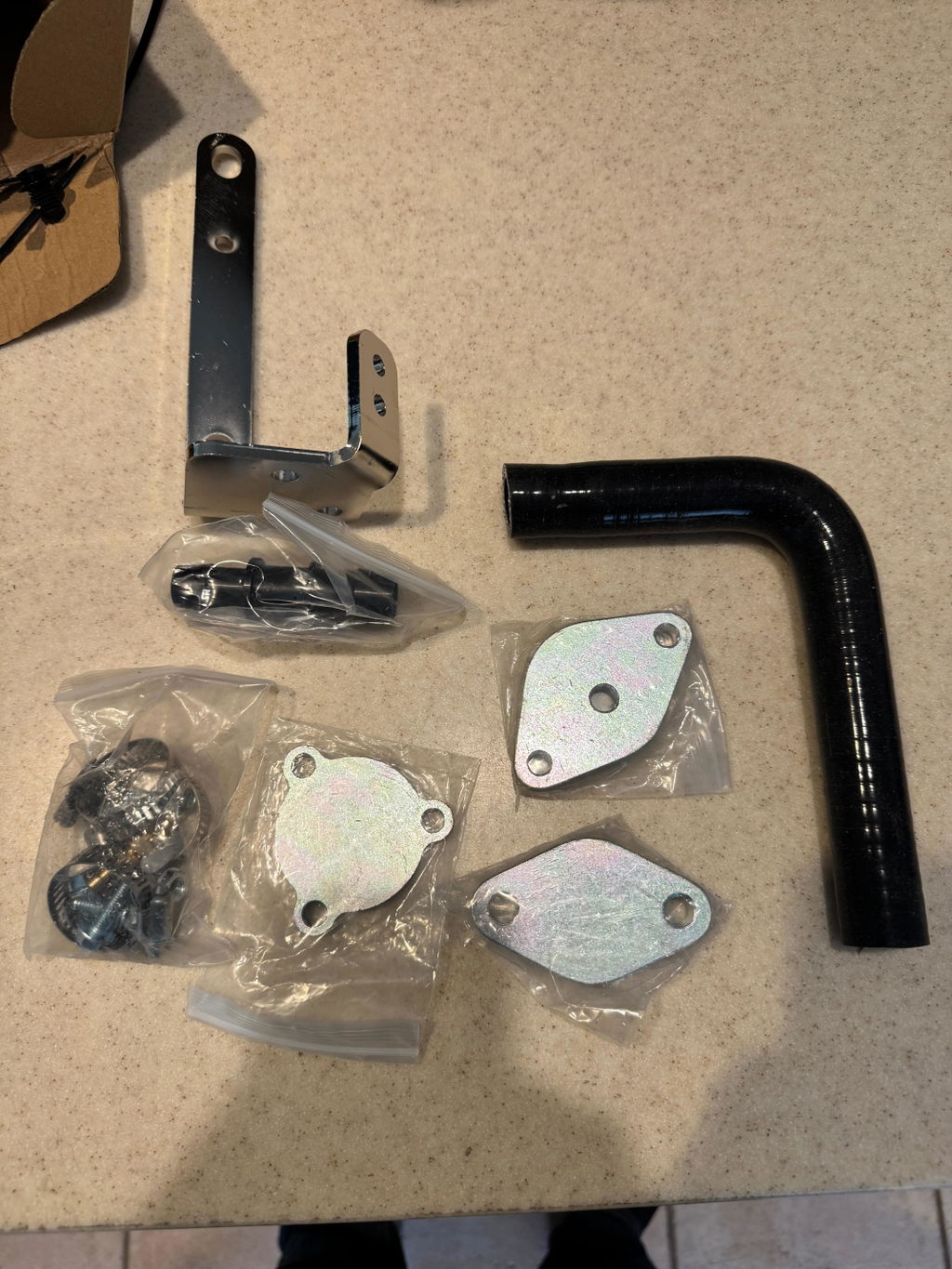
If you ordered the TruckTok EGT relocation kit, here’s what you should see:
- EGT probe adapter — 1/8" NPT male to M14x1.5 OEM female (stainless steel)
- Extended wiring harness — high-temp insulated, plug-and-play connectors
- Cable ties and loom — for clean routing
- Optional: Drilled & tapped 1/8" NPT bung — for welding onto your delete pipe
If your delete pipe doesn’t have a pre-threaded bung for EGT sensors, you must order the version with the weld-in bung.
Tools You’ll Need
| Tool | Why |
|---|---|
| 13mm & 15mm sockets | Sensor removal from DPF |
| 7/8" or 22mm wrench | EGT sensor body |
| Wire cutters & crimpers | If cutting/splicing (avoid it) |
| Heat-resistant loom | Protecting the extension harness |
| Zip ties | Securing the harness away from heat |
| Anti-seize compound | On the new adapter threads (copper-based) |
| Welder (optional) | Only if welding the bung yourself |
| Jack & jack stands | Absolutely. Never work under just a jack. |
Step-by-Step Install
Step 1: Disconnect the Battery
Negative terminal off. You’re working near sensors that talk to the ECU — don’t risk a short.

Step 2: Locate the EGT Sensors
Jack up the truck, put it on stands. Crawl under the passenger side. You’ll see your exhaust from the turbo back.
The EGT sensors look like small metal probes with a hex body and a wire pigtail coming off them. There will be:
- One in the exhaust manifold (leave it)
- One just after the turbo (this is usually EGT 2 — the one you’re relocating)
- One or two in/after the DPF (these get deleted)
Step 3: Remove the Sensor(s) You’re Keeping
Spray the sensor base with penetrating oil (PB Blaster or Kroil) and let it sit for 10 minutes. These sensors bake into place after years of heat cycling.
Use the 7/8" wrench on the sensor body — not pliers on the wire. If you damage the sensor, it’s $80-150 to replace.
Once loose, unplug the connector from the factory harness. The connector has a small tab — press it, pull, don’t yank.
Step 4: Install the Bung (If Your Pipe Doesn’t Have One)
Skip this step if your delete pipe came with a pre-threaded 1/8" NPT port.
Otherwise:
- Mark the spot on your delete pipe where you want the sensor — ideally 4-6 inches after the turbo flange
- Drill a hole with a step bit
- Weld the 1/8" NPT bung in place
- Let it cool completely before threading anything in
Not a welder? Most exhaust shops will weld a bung for $20-40. Well worth it.

Step 5: Thread the Adapter
Apply a small amount of copper anti-seize to the 1/8" NPT threads on the adapter. Screw it into the bung hand-tight, then snug with a wrench. Don’t overtighten — NPT threads seal on taper, not torque.
Step 6: Install the Sensor Into the Adapter
Thread your EGT sensor into the M14x1.5 female side of the adapter. Hand-tight, then 1/4 turn with a wrench. No sealant needed — the sensor has its own crush washer.

Step 7: Connect the Extension Harness
The TruckTok kit uses a plug-and-play harness — no cutting, no splicing. The connectors are keyed and only go one way.
Routing tips:
- Keep the harness at least 3 inches away from the exhaust pipe
- Use zip ties to anchor it along the frame rail
- Wrap any exposed section with heat-resistant loom
- Avoid routing near moving parts (steering shaft, driveshaft)
Step 8: Double-Check Everything
Before dropping the truck:
- All connections clicked in
- Harness secured, no sagging onto the exhaust
- Bung adapter tight
- No tools left in the engine bay
Step 9: Reconnect Battery & Test
Reconnect the negative terminal. Start the truck and let it idle for 5 minutes. If your tuner has a live data display, check that EGT readings look normal — they should climb slowly as the engine warms up.
No CEL? No weird temps? You’re done.
EGT Temperature: What’s Safe After Relocation
Once your EGT2 sensor is relocated and reading live, here’s the range you should expect. These are exhaust gas temps at the sensor, not cylinder temps — use them as your everyday sanity check:
| Driving Condition | EGT Reading | What It Means |
|---|---|---|
| Idle / warm-up | 300–500°F | Normal slow climb as the engine warms |
| Empty highway cruise | 600–900°F | Healthy safe zone |
| Towing uphill (heavy load) | 1000–1250°F | Sustainable upper limit — watch it here |
| Wide-open throttle / passing | 1300–1450°F | Brief peak only, don’t hold it |
| Above 1450°F | ⚠️ Danger zone | Lift off, downshift, let it cool immediately |
If your relocated sensor pegs at 1450°F+ under normal towing, something’s off — either the tune is too aggressive for your fuel, or the sensor is reading false-high from a bad ground. Don’t ignore it; EGT is your cheapest engine-saving gauge.
Common Mistakes to Avoid
1. Buying an M12 Kit for a 2013+ Truck
I said it once, I’ll say it again: 2013+ Rams use M14x1.5. If the listing doesn’t specify the thread pitch, message the seller before buying.
2. Skipping the Anti-Seize
Stainless adapter into a steel bung — galvanic corrosion will weld them together without anti-seize. A $3 tube of copper anti-seize saves a world of pain later.
3. Not Protecting the Harness
That extension harness runs through the engine bay near 1,200°F exhaust components. Cheap split loom melts. Use the good stuff — silicone-coated fiberglass loom rated for 500°F+.
4. Overtightening the NPT Adapter
NPT threads seal by taper, not by cranking them down. Overtighten and you’ll crack the bung or strip the threads. Snug + 1/8 turn is plenty.
5. Not Verifying the Tune
Your tune controls which sensors the ECU monitors. If your tuner disabled EGT 2 entirely, you just spent an afternoon relocating a sensor the ECU is ignoring. Confirm with your tuner before you start.
Need more help? Our TruckTok Forum has detailed installation walkthroughs with photos from other 2013+ Ram owners, torque specs, and live Q&A for troubleshooting. Browse EGT install threads →
FAQ
Will this kit work on a 2022+ Ram?
Yes. All 2013-2024 Ram 2500/3500 6.7 Cummins use the same M14x1.5 EGT sensors. The harness connectors are unchanged across the entire generation.
Can I install this without welding?
Only if your delete pipe came with a pre-threaded 1/8" NPT bung. If not, you need the full kit with the weld-in bung — or have an exhaust shop weld it for $20-40.
Do I need to disconnect the batteries?
Yes. You’re unplugging and reconnecting ECU-monitored sensors. A voltage spike can fry a sensor or, worse, the ECU. It takes 30 seconds — just do it.
My tuner says the tune codes out EGT. Do I still need this?
If the tune completely disables EGT monitoring, you don’t need the relocation kit. But you lose your most important engine safety gauge. We recommend keeping at least one EGT sensor active if you tow anything.
How do I know if my kit has the right thread pitch?
If it’s a TruckTok or BD Diesel kit labeled for 2013+, it’s M14x1.5. If it’s a generic kit and the listing doesn’t specify, assume it’s M12 — wrong for 2013+. Message the seller before buying.
Will this cause a check engine light?
Not if installed correctly with a matching tune. If you get a CEL after install, check: (1) connector is fully seated, (2) no wires touching the exhaust, (3) your tune hasn’t disabled the sensor you just relocated.
Can I reuse my factory EGT sensor?
Yes — that’s the whole point. The kit extends your factory sensor’s wiring so you don’t need to buy new sensors. Just handle them gently when removing.
What if my delete pipe already has a bung but it’s the wrong size?
Most delete pipe bungs are 1/8" NPT, which is what the adapter uses. If yours is different (rare), you’ll need to weld the included bung in a new spot instead.
My EGT reading shows -40°F or jumps around after install — what’s wrong?
That’s almost always a wiring or connection issue, not a sensor failure. Work through this:
- Connector not fully seated — the plug-and-play connector clicks but can feel seated when it isn’t. Unplug, inspect the lock tab, and push until it audibly clicks.
- Harness touching the exhaust — if the extension runs within ~3 inches of the pipe, heat cooks the insulation and the signal goes erratic. Re-route with the heat-resistant loom and zip-tie it to the frame rail.
- Ground issue — -40°F is the ECU’s “open circuit” default. If the sensor ground isn’t solid, you’ll see it. Confirm the adapter threads are clean metal-to-metal (no paint, no anti-seize on the sensor side — only on the NPT side).
- Wrong sensor relocated — if you moved EGT1 (pre-turbo, in the manifold) instead of EGT2, the reading range and behavior will look wrong. EGT2 is the one this kit is built for.
If it still reads -40°F after all four checks, the sensor itself may be damaged — handle them gently, they’re $80–150 to replace.
Do I need to relocate EGT1 (pre-turbo) too, or just EGT2?
Just EGT2. The EGT1 sensor lives in the exhaust manifold before the turbo and stays put — the DPF delete doesn’t touch it, so there’s no reason to move it. This relocation kit is built for EGT2, the post-turbo sensor that sits in the deleted section of the exhaust. If your tuner monitors EGT1 only, you don’t need this kit at all. If it monitors EGT2 (most do), relocate that one and leave EGT1 alone.
One Last Thing: Legal
This kit is sold for off-road and competition use only. Removing or relocating emissions equipment on a vehicle driven on public roads may violate federal and state laws. Know your local regulations before you turn a wrench.
Got questions about your specific truck? Drop a comment below or reach out to us at service@trucktok.com — we answer install questions personally.